
Mission Buniyaad - How Personalised Learning Is Helping Girls Stay in School in Rajasthan
.webp)
Executive Summary
Mission Buniyaad is one of India's largest government-led Personalised Adaptive Learning (PAL) programmes, implemented by the Government of Rajasthan with support from the Children's Investment Fund Foundation (CIFF) as the funder and ConveGenius as technical implementation partner. Since 2021, the programme has worked to strengthen foundational learning and improve educational continuity for adolescent girls through SwiftPAL, ConveGenius's personalised adaptive learning platform — deployed as one of the country's largest PAL rollouts inside government schools.
The programme has reached nearly 5 lakh girls across approximately 3,700 government secondary schools in Rajasthan between 2020 and 2025. Girls' learning outcomes have improved by approximately 20%, and board examination failure rates have reduced by 4–6 percentage points. On this basis, the Government of Rajasthan has approved the expansion of 1,000 AI-enabled PAL Labs.

Why Rajasthan Needs Mission Buniyaad
For many girls in Rajasthan, a good marksheet is more than an academic achievement — it becomes an argument to stay in school, delay marriage, and negotiate a different future. This is the environment Mission Buniyaad was designed to work inside
- Rajasthan's sex ratio at birth is 888 girls per 1,000 boys (NFHS-5, 2019–21), reflecting a deep-rooted preference for sons that shapes childhood itself. In 2019 alone, 36 cases of female infanticide were recorded in the state.
- 25.4% of women aged 20–24 were married before the age of 18 (NFHS-5) — down from 35.4% in the previous survey round, but still significant enough to shape decisions about a girl's schooling.
- Girls' secondary school dropout rate stands at around 13–14% (UDISE+ 2023–24), with a further 5.3% of girls dropping out before transitioning from upper primary to secondary school.
- NCRB 2023 data recorded over 10,500 cases of crimes against children in the state — a 70% surge over the 2018–22 average — directly affecting whether families allow girls to travel for school or continue past a certain point.
- Even where girls clear school-level barriers, Rajasthan's female Gross Enrolment Ratio in higher education stands at around 28% (AISHE 2021–22) — an improvement from 15–18% a decade ago, but still behind states like Tamil Nadu and Kerala.
- 451 dowry deaths were recorded in the state in 2022 (NCRB) — the fourth highest in the country — a reminder that marriage continues to shape a woman's life trajectory in Rajasthan regardless of her education.
- Many girls leave school due to household responsibilities, financial pressures, safety concerns, and early marriage expectations.
“For many boys, poor marks may limit opportunities. For many girls, they can end education altogether — which is exactly why every additional year in the classroom matters for them.”
About Mission Buniyaad
- Started: 2021
- Coverage: ~3,784 government schools
- Reached: ~5 lakh girls
- Approach: Personalised Adaptive Learning (PAL) through SwiftPAL
- Government Ownership: Integration into state systems, dashboards, and AI PAL Lab expansion
- Future Scale-up: 1,000 AI-enabled PAL Labs approved by the Government of Rajasthan.
Programme Approach
Built on three pillars:
- Reviving dormant ICT labs to create learning access at minimal incremental cost.
- Designing gender-responsive personalised learning content to rebuild confidence among adolescent girls specifically.
- Embedding PAL into school timetables, teacher roles, and government review mechanisms — rather than running it as a parallel initiative.
- Using data and dashboards to support teachers and education officials in identifying exactly who needs help, and where.
SwiftPAL diagnoses exactly where a student's understanding breaks down, at the concept and sub-concept level — often tracing a Grade 9 struggle back to an unresolved gap in fractions or linear equations from an earlier grade. It remediates only that specific gap, then moves the student forward once mastery is confirmed: precision intervention rather than repeating whole grades or whole-class instruction.
Beneficiary Story
.webp)
The Education department (GOR) significantly enhanced the reach and impact of PAL by actively promoting it through strategic social media handles, thereby increasing awareness, engagement, and adoption among educators, students, and stakeholders.
Article co-authored with Govt.webp)
Monthly governance lead by district / state officials, in which overall performance reviewed along with Mission Buniyaad schools
Board Result Analysis (AY 2022–2026)
Board Result Analysis 2026 compares pass-rate trends across four cohorts of Rajasthan schools between AY 2022 and 2026: 3829 schools with programme exposure and the Overall State average.
.webp)
Class 10th Pass % — AY 2022–2026
Class 12th Pass % by Stream — AY 2022–2026
.webp)
Arts

Science
.webp)
Commerce
3829 Commerce stream has held a 100% pass rate for three consecutive years (2024–2026).
Why This Story Matters
Mission Buniyaad demonstrates that personalised learning, when embedded within government systems, can improve learning outcomes at scale and help keep girls in school. Every additional year of schooling can change the trajectory of a child's life, and every mark earned can represent another chance to stay in school.
.webp)
Bringing stakeholders, educators, and leaders together to scale impactful foundational learning through Mission Buniyaad
For us, this is ultimately a question about reach and evidence: whether learning technology reaches the children who need it most, under the hardest conditions, and whether that reach shows up in outcomes a funder — and independent academic evaluation — is willing to stand behind. Mission Buniyad answers with numbers that come from outside ConveGenius: 500,000 girls, a 20 percent gain in test scores, a measurable drop in exam failure, a Nobel laureate’s independent evaluation of a related deployment, government approval of 1,000 AI-enabled PAL Labs, and now a proposed second state carrying the model into a wider grade range.
“Rajasthan's girls keep outperforming boys not because the system makes it easy for them, but because they have far more to fight for. Mission Buniyaad is one part of what is starting to tip that fight, marginally but measurably, in their favour.”
Read More from
ConveGenius

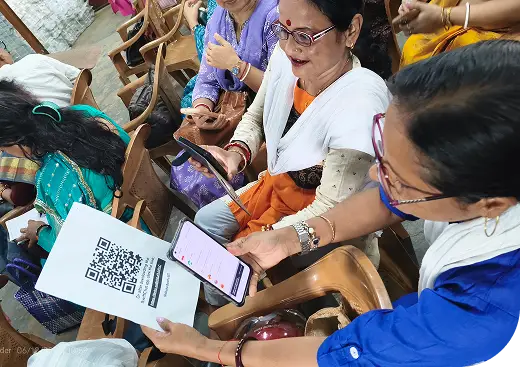
From Data Gaps to Decisive Action: Tripura’s VSK Transformation
Over two years, Tripura's Vidya Samiksha Kendra transformed from a tedious, error-prone offline reporting system into a trusted, data-backed decision engine. A Grade 2 assessment across the state's schools led to three evidence-driven PAB proposals, with state officials now calling VSK data the "source of truth." The state is now scaling spot assessments to Grade 5 across 4,100+ schools, aiming for a top-10 PARAKH finish.
Learn More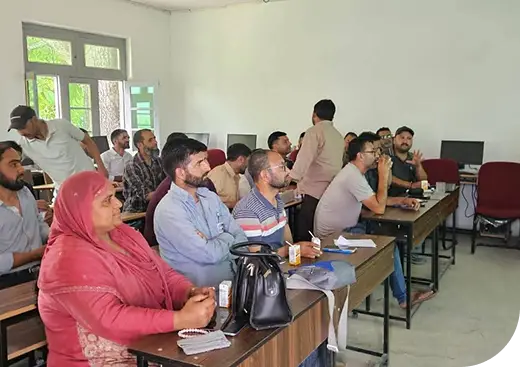
From Hesitation to Adoption: J&K’s Teacher Technology Breakthrough
J&K's VSK rolled out the Shikshak Sahayak chatbot to teachers, overturning assumptions that senior educators struggle with technology. A ten-day mission-mode push took registrations from 25,000 to 65,000+ against a 70,000 target, now at 71,821 profiles. The clearest proof: Classes 9-12 teachers, not yet covered, have begun requesting inclusion unprompted, pulling SCERT toward expansion into new grades and regional languages.
Learn More
The Story Behind the Stories
Behind every field story in this newsletter sits ConveGenius's Market Presence & Brand team, turning WhatsApp updates and voice notes from Uttarakhand, Rajasthan, J&K, and Tripura into investor narratives, RVSK reports, and advocacy stories. What makes it sustainable isn't one well-written piece but a repeatable pipeline, and a cultural shift where field teams now volunteer their stories as habit, not compliance.
Learn More